Voice Typing: My Keyboard Has Gathered Dust
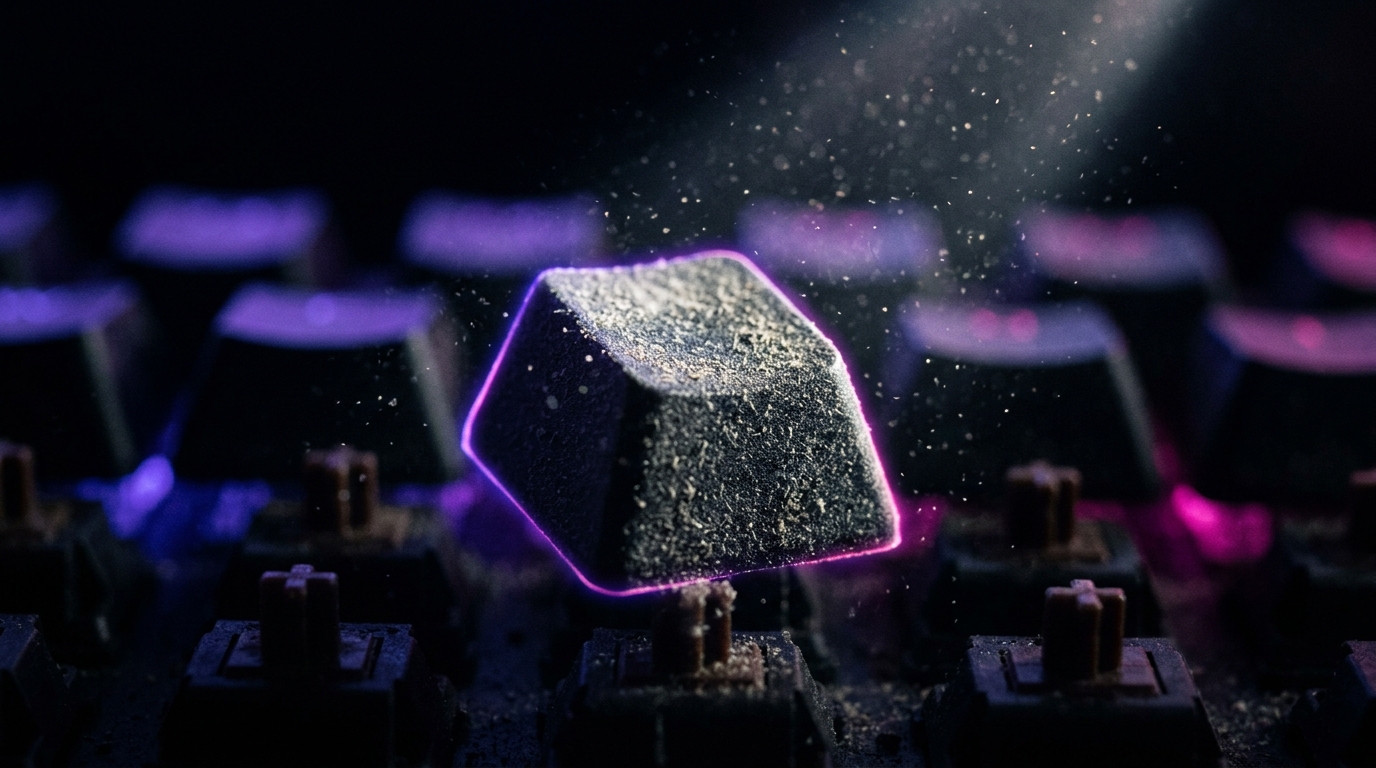
Today I shot a phone video for my wife — to show her how I have my home desk set up. I tilted the camera, ran my finger across the F key, and… picked up a visible layer of dust on my fingertip. The number row has even more. The keys with brackets and braces ({, }, [, ]) are about as clean as the shelf behind the cabinet.
This is the physical ROI of Commander Flow.
Where the dust came from
I have a mechanical keyboard with brown switches. Until September, I cleaned it weekly — shook out the crumbs, blew out the dust, wiped it down. Now? I can't remember the last time I did that.
Simple reason: I barely type anymore. My day looks like this:
- 06:30 — coffee, open Telegram, reply to everyone by voice via the hotkey
- 07:00 — Gmail, dictate ten emails in a row
- 09:00 — work call, voice notes in Obsidian between the other person's sentences
- Throughout the day — Slack, Discord, GitHub issues, all by voice
- Evening — LinkedIn posts, also by voice
Real typing now lives in three places: terminal commands, passwords (once a day, sometimes not even that), and hotkeys. Everything else is Commander Flow.
"I stopped noticing I have a keyboard. That's a bad dust test and a great tool test."
What surprised me more than the dust
Silence. I work in a rented apartment with thin walls. For years my neighbors heard the mechanical clatter — especially Enter, which I always hit too hard. Now the only sound in the apartment is my voice, low, totaling maybe 5–10 minutes per hour. My downstairs neighbor said in passing: "something changed up there, it's gone really quiet." I didn't get into the offline-LLM explanation.
I'm not a "voice person" — that's the trick
Before Commander Flow, I had never used voice input. Siri annoyed me. Google Assistant too. I had no habit of "talking to a device." If you'd told me in 2024 I'd switch to voice input, I would have laughed.
What flipped the switch?
Nothing leaves my computer. I work with confidential client documents. Any cloud-based dictation tool was a non-starter for me, NDA alone. Commander Flow runs Whisper and an LLM locally — I can dictate the contents of any contract and not worry. That removes the main barrier.
No "commands" — just regular dictation. You don't have to say "OK Google, write an email." You hold the key and talk like you think — exactly the way you'd type. No wake word, no awkward "I am addressing the assistant" ritual.
What still bothers me
I was asked to write honestly, not as promo. So:
I can't dictate on public transit. I mean, I can, but people stare. That's my personal social problem, not a software issue, but the fact remains: on a laptop in a café I dictate quietly into my collar, and it looks weird. The fix is getting used to it. After a month I stopped feeling self-conscious.
On loud calls the hotkey sometimes misses the start. If I'm already on the phone and dictating into Slack at the same time, the VAD picks up someone else's voice. It's a rare scenario but it happens. The team is working on binding capture to a specific input device.
A side effect no one expected
I started speaking better in real life. Not faster, not louder — more structured. Months of dictating emails and posts trained me to formulate a thought in a single sentence. My wife joked the other day that I "now talk the way I write." That was before she found out I no longer write.
What's left of the old keyboard
That dusty keyboard? It's still on my desk. I haven't put it away, replaced it, or downsized to a smaller one. I need it for terminal commands, passwords, and IDE shortcuts. It just went from being my main tool to being a backup.
The product has done a lot of different things, but this specific effect — turning a primary tool into a backup — is the most unexpected.
Try it yourself
Download Commander Flow and hold Caps Lock in any app. Recognition runs locally, no cloud — dictation is free forever.